Greg Hinkle already wrote it: JBossON 2.2 has been released. This has been a big release for us - with arounds six month of work.
Some of you may already had a peek at the Jopr 2.2 beta and my know about some of the new stuff.
Changes were (in addition to hundreds of small enhancements and bugfixes):
* UI - Completely updated (and mostly rewritten from Struts to JSF), AJAX based UI with tree views, search and common menu system * Clusters - Cluster oriented tree views with group-wise configuration management and monitoring * Security - Improved DynaGroups queries and new support for recursive compatible groups simplifies access control * Monitoring - Configuration change detection, auditing and historical review * Agent auto upgrade - Agents automatically update themselves when new servers are installed * Subsystem views - Pages that e.g. show alert info over all existing resources * Much better IE support * Speed improvements * Automatic recalculatin of DynaGroups * Plugin skeleton generator
More information about JBossON 2.2 can be found at http://www.jboss.com/products/jbosson
I am just working on a plugin when I have some spare cycles (I will tell you which one in a few days :-)
To test the plugin I am using the Standalone Container where I have deployed my plugin, the JMX and the platform plugin. So when I have compiled a new version of the plugin I just copy it over and start the standalone container:
snert:rhq-agent hrupp$ bin/standalone.sh

Listening for transport dt_socket at address: 8788


Starting the plugin container.

Loading plugins

...Loaded plugin: Platforms

...Loaded plugin: JMX

...Loaded plugin: MyNewOne


Ready.

[0]:0 >
This takes 3 seconds and then I am ready to discover resources:
So set the resource id to the resource I want to work with and then invoke the getProperty operation with parameter name and value test. The Operation then returned null, as the underlying resource does not know this specific value.
This all took around 10 seconds now for a round trip - you can't really do faster testing :-)
When I want to repeat those steps with an updated version of the plugin, I can save my work:
[4]:-3 > !w /tmp/foo
This creates a file and saves the commands given in it. The name of the file can later be given on the command line to just run the action as a script without any need to manually type in the commands.
There is currently one caveat: Resource ids will change in each startup so the "set" command in step 2 above will not work exactly like this.
[UPDATE]
I will work on adding variables to the find command in the standalone container which can then be passed to set -- if you want to help out contact me.
What you can do is to use $r as 2nd parameter to set after finding a single resource:
[5]:0 > find r *myFooBar*

-12: MyFooBar ( Resource[id=-3, ... )

[6]:0 > set r $r

[7]:-12 >
With this trick it is now possible to just run the container with the saved file as input again and again
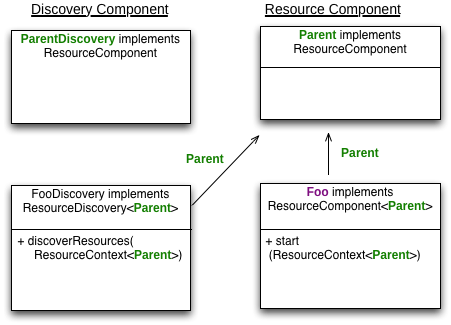
When writing a Plugin for RHQ, JBoss ON and Jopr (or for completeness: Embedded Jopr, you will run into Generic types for ResourceComponent and ResourceDiscoveryComponent. And I am sure you have often wondered what the T in ResourceComponent<T> should be.
The following diagram tries to help here. We have two ResourceTypes that from a Parent-Child relationship e.g. a Database and a DatabaseTable.
If you don't know what parent you will run in, you can just leave the generic bit away, as in ParentDiscovery and Parent in the diagram. This is usually the case for ResourceTypes of the Server category that live in their own plugin. One could also use the platform component as parent if its clear that the plugin will only run as a child of the platform, but never e.g. within another resource like a JBossAS.
Children of this server Parent will set the T to the parent component. This allows them to e.g. access the parent ResourceContext.
For examples of all this, check the Jopr source code, which contains many examples.
Today it was raining, but I had the urge to go out for a run, so I went out nevertheless. Normally I am more a like a sissy in that area though.
But after around 1km I felt warm enough so that it did not feel uncomfortable anymore and later on it did not even feel bad being splashed by a car driving through a puddle. And this is how I looked when I was coming home:
But hey, it felt great !
And the best: my Adidas (Supernova) shoes stayed dry inside. No wet feet - I just love those.
( The very best was actually that my ankle did not hurt )
The plugin generator has been updated for the plugin lifecycle listener. I have uploaded a new version to the description page on the RHQ wiki. So you can grab the standalone jar file from there without the need to download the RHQ source and compile it from scratch -- which would not be hard actually:
$ cd $RHQ/modules/helpers/pluginGen

$ mvn install
You can find the resulting rhq-pluginGen*-jar-with-dependencies.jar in target/ then.
I have been working on a standalone plugin container wrapper for RHQ and Jopr which allows to call plugin functionality without the need for a fully running agent and server. Of course this only makes sense while developing a plugin.
To get to Düsseldorf, I took the ICE fast train which took 2:41h for 410km distance, which is the fastest way to travel between those cities. On this course, Deutsche Bahn is offering WiFi on board (unfortunately not for free), so you basically have Internet at 300km/h - nice. While being on the train I also started about implementing a Standalone PluginContainer wrapper that can be used when implementing a new plugin to test it; I will post about this separately.
After I arrived in Düsseldorf I first went to my Hotel, which is nicely located in the old town - only 5 mins by subway from the main station. after check in I walked around a little bit in the old town and went to the Rhein river. On the next picture you can see locals with one of their favorite occupations:
People were just standing outside a brewery and drinking Altbier. In summer that place is crowded.
Düsseldorf is supposed to have "die längste Theke der Welt" ( 'the longest bar counter of the world', which is not to be taken literally ) see also:
There are lots of other restaurants and bars in that area too, as you can see from this picture:
I took the tram to the Heinrich-Heine-University where the talk was taking place in an auditorium. The first people were already there and enjoying food and drinks sponsored by Red Hat Germany.
Michael Jastram from the JUG opening the evening by welcoming all of us and doing a little lottery - prizes were a Jetbrains license, a backpack and a copy of my EJB-3 book.
After this my colleague Joachim Schröder who is living close to Düsseldorf briefly introduced Red Hat before my talk started:
My talk was taped by the user group and should soon be available on the Rheinjug.tv web page
(Installation of the camera)
Around 40 people had found their way to the presentation at that time. The talk itself went well. As usual I was also talking about the thermometer chip monitoring that I implemented a while ago. And of course I did a live demo of the system which was well received. In the Q&A session we had some good questions from people who obviously have an administration background.
When this "official" part was over we relocated to a different part of the building and did some more socializing.
Joachim drove me to my hotel, where I arrived around midnight. While this he told me that he especially found the thermometer chip part very interesting, as he recently implemented some monitoring of his heating system with this exact chip and with some proprietary code. So he is now interested in replacing this with a Jopr based solution :)
This morning when I went back to the main station, I met Mete again, who was in the talk yesterday. He invited me for a coffee (thanks again) while I was waiting for my train and we had another good conversation.
Sometimes it is necessary in RHQ-plugins to load resources when the plugin is loaded and more important to unload those when the plugin is unloaded from the plugin container.
( As you can see from the comments, Mazz has renamed the Interface class, so I updated this article. )
Mazz has recently added the PluginOverseerPluginLifecycleListener interface for exactly this purpose (see e.g RHQ-1584).
To use the api, you need to do two things:
Implement the interface org.rhq.core.pluginapi.plugin.PluginLifecycleListener
Wire the implementation class in the plugin descriptor.
With the following entry in the plugin descriptor, rhq-plugin.xml
<plugin name="MyPlugin"

     package="org.rhq.plugins.myPlugin"

   pluginLifecycleListener="MyPluginOverseer" .../>
The code for this could look like this: package org.rhq.plugins.myPlugin;
Going to Karlsruhe to talk to the local Java User Group was a little bit like going back in history - I used to live for over 10 years in Karlsruhe and did study computer sciences at the University. So I was giving the talk in an auditorium where I used to sit my self on the benches years ago.
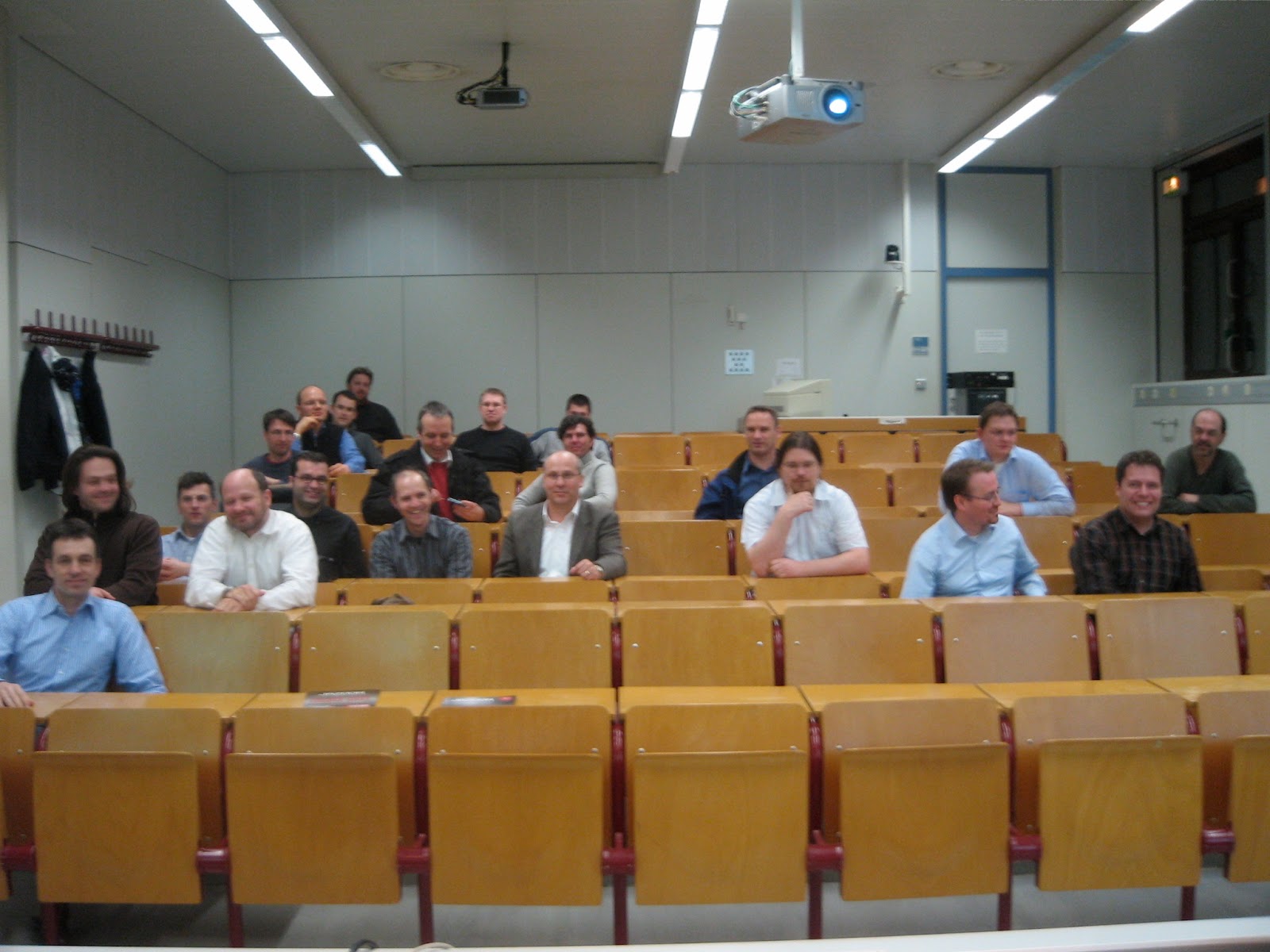
I went to Karlsruhe by train, took the tram to the city center and then walked to the University and the CS building. When I arrived the first two members of the audience have been there. David who used to organize the event unfortunately got ill and was not able to attend. After some waiting, the audience grew to more than 20 people.
Before I started my talk, there was a presentation about Jazoon by Christian Frey. Christian explained why it is worthwhile to attend Jazoon and left some vouchers for user group members.
Christian Frei talking about Jazoon
Next was my talk, which went well. The audience was interested and from the questions, it was obvious that at least some of the members have management and monitoring experience. This also resulted in some good new ideas.
Of course I did a live demo of the latest Jopr 2.2 beta 1 release.
After the talk there was some Q&A and then (nearly) everyone went home quickly as it was already past 9pm.
I wanted to reconfigure my Oracle-XE instance to run the tnslsnr on port 1522 instead of 1521. So as first try I went in and just changed the listener.ora and tnsnames.ora files. But after those changes, the system did not give away a beep when I e.g. called lsnrctrl status.
The script asked some questions about ports (you can look them up in the copy in /tmp) and the db password etc. And then started the database with the new port.
Apple has introduced a new keyboard that has a cable and does not have the numeric keypad, making it much smaller than the already existing one with keypad. Actually as it does not need the battery casing, it is even smaller than the wireless one (see e.g. http://www.apple.com/keyboard/ ) and http://store.apple.com/de/product/MB869?mco=NDE4NDE5NQ for the new one in the German Apple store.
And you can immediately see that this is a real Apple product, as it is the same price as the one with keypad :-/
As I have written earlier, there is a page available that shows an overview of the UI features - but of course it is better to try them yourself.
Please provide feedback
We have two jira systems as development effort is split between the foundation RHQ Project and the Jopr Project that is specific to JBoss technology management.
Install documentation is available in the JBoss.org wiki.
Note, that there is no longer a separate agent download. The agent is delivered with the server package and you can install it as I have described here.
As written previously, I will talk next wednesday, March 11th at the Karlsruhe Java User Group about Jopr, RHQ and JBoss ON. This will of course also include new Jopr 2.2 features.
The talk will be in the CS building of University of Karlsruhe