Tuesday, February 26, 2013

RHQ 4.6 released


As I've mentioned before, the RHQ team has been very busy since RHQ 4.5.1 (and actually already before that) and has switched the application server it uses to JBoss AS 7.1. Directly after the switchover we have posted a first alpha version.


Now after more work and fixes, we are happy to provide the release 4.6 of RHQ, that has all the issues resolved that arose from the switch. Features of this release are:

  • The internal app server is now JBossAS 7.1.1
  • GWT has been upgraded to version 2.5
  • There is a new installer (this has also changed since the 4.6 alpha release)
  • The REST-Api has been enhanced
  • Korean translations have been added (contributed by SungUk Jeon)
  • Webservices have been removed
  • Building RHQ now requires Java7, but it will still run on Java6
.

See the full release notes for details. They also contain a list of commits.

You can download the release from source forge.


As mentioned above, the old installer is gone, so make sure to read
the wiki document describing how to use the new installer.

Maven artifacts are available from the JBoss Nexus repository and should soon also be available from Central.

We also like to say thank you to our contributors for this release:

  • Jürgen Hoffmann
  • Richard Hensman
  • SungUk Jeon


Please give us feedback, be it in Bugzilla, Mailing lists or the forum. Or just join us on IRC at irc.freenode.net/#rhq.

Tuesday, February 19, 2013

Best practice for paging in RESTful APIS (updated)?

In the RHQ-REST api, we return individual objects and also collections of objects. Some of those collections are rather small (number of platforms), while others can grow a lot (number of resources in total or number of alerts fired). For the latter it is advised to do some paging and not return the full result set in one go. Some of the reasons are:
  • Memory consumption in server and client
  • Bandwidth need to transfer the data.
  • Latency to transfer huge amounts of data over slow networks


Inside RHQ we have the concept of a PageList<?> where an internal PageControl object defines the page size and other criteria like sorting. The PageList then only contains the objects from a certain page. I think this is a pretty common setup.

And here is where my question comes:

What is the "best-practice" to represent such a PageList in a RESTful api? So far I have seen two major ways:
  1. Add a Link: header that contains the prev and next relations. This is what RFC 5988 suggests and what projects like AeroGear use. The advantage here is that the body still contains the "raw" data and not meta data. And for both cases of 'single' object and 'collection' the data is at the 'root' of the body. Also paging is available for HEAD requests.

    On the other hand, it may get a bit harder for some client code (JavaScript, jQuery) to access the header and make use of the paging links
  2. Put the prev and next relations in the body of the request next to the collection. This has the advantage that there is no need to parse the http header. Disadvantage is that the real payload is now shifted "one level down" for collections.


    I sort of see the paging links as meta-data and think that this should not be mixed with the payload. Now a colleague of mine said: "Isn't that a state change link for the collection like the 'rel=edit' for a single object?". This sounds odd, but can't be denied.

Actually I have also seen mentioning the use of cookies to send the paging information, but that looks very non-transparent to me, so I am not considering this at all.

Just to be clear: I am explicitly talking about paging of collections and not about affordances of individual objects.

So are there established best practices? How do others do it?

If going for the Link: header: would people rather like to see multiple Link headers (see RFC 2616), one for each relation:

Link: <http://foo/?page=3>; rel='next'
Link: <http://foo/?page=1>; rel='prev'

or rather the combined way:

Link: <http://foo/?page=3>; rel='next', Link: <http://foo/?page=1>; rel='prev'

that is listed in RFC 5988?

[update]

I just saw that URLConnection.getHeaderField(name) does not support the multiple Link: headers as it only returns the last occurrence:

If called on a connection that sets the same header multiple times with possibly different values, only the last value is returned.


While there may be other ways to access all the Link: headers, this is a too obvious pitfall, that can be prevented by not using that style.

Tuesday, January 29, 2013

When an annotation processor does not process...

In RHQ we have the rest-docs-generator that takes annotations from the code and turns them into xml. As you may have guessed from the last sentence this is implemented as a Java annotation processor and used to work quite well.

Yesterday I wanted to run it on the latest version of the code (we don't run it on every build, as it takes some time with all the backend processing) and it failed. Looking at the processor itself and its test runs did not reveal anything, as they continued to work.

As we use the maven processor plugin, I thought this may fail because we now use Java7 to build (but then I used that before too) and upgraded the plugin, but that did not help. In the end I switched to the maven compiler plugin, which spit out a ton of errors and stacktraces. It turned out, that one of the classes on the classpath had an unsatisfied dependency and the annotation processor just "died" silently before.

After adding the dependency, the errors were gone, but the Processor.init() method was still not called and no processing happened. Looking through tons of output I found this:


Processor <hidden to protect the innocent> matches
[javax.persistence.PersistenceContext,
[……]
javax.ws.rs.Consumes,
javax.interceptor.Interceptors, com.wordnik.swagger.annotations.Api,
javax.ejb.Startup] and returns true.

This "returns true" together with the list of annotations I am interested in means that this other processor that is now in the classpath (probably pulled in when we switched from as4 to as7) swallows all those annotations, so that they are not passed to our processor.

The solution in my case was to explicitly name the rest-docs-generator in the compiler plugin configuration and not to rely on the auto-discovery (I did that in the processor plugin already, but it looks like this had no effect in my case) :


<plugin>
<groupId>org.apache.maven.plugins</groupId>
<artifactId>maven-compiler-plugin</artifactId>
<version>3.0</version>
<configuration>
<annotationProcessors>
<processor>org.rhq.helpers.rest_docs_generator.ClassLevelProcessor</processor>
</annotationProcessors>

<proc>only</proc>
<compilerArguments>
<AtargetDirectory>${project.build.directory}/docs/xml</AtargetDirectory>
<AmodelPkg>org.rhq.enterprise.server.rest.domain</AmodelPkg>
<!-- enable the next line to have the output of the processor shown on console -->
<!--<Averbose>true</Averbose>-->
</compilerArguments>
<!-- set the next to true to enable verbose output of the compiler plugin -->
<!--<verbose>false</verbose>-->
</configuration>
[…]


Note that to find the above "Processor .. matches .." output, the compiler plugin must be set to verbose.

I meanwhile also heard that a newer version of that "rouge" processor only looks after its annotations now.

Monday, January 28, 2013

Recap of RHQ @ LJCs first Meet a Project event

RHQ-logoLJC logo

Last thursday I was in London at the London Java Community (LJC) first "Meet a project" event.

Getting there started with an aborted take-off in Stuttgart. The plane accelerated on the runway and then all of a sudden did a full breaking. We exited onto the movement area, parked there for some minutes and then circled back on to the runway to finally take off. But anyway, I arrived safe and early enough in London.

The "Meet a Project" (MaP) event was held at the University College London campus. When I arrived a few attendees were already there and soon after Barry, the organizer joined too. We started in one room to explain "the rules" and then split into three rooms.

Me in the very last session of 6

Myself talking at the back table in the last of the six sessions.


To explain how MaP works, one can think of "speed dating for projects". There were six projects present and thus six groups have been formed, each sitting around a table. The project ambassadors (like myself) then spend 15 mins per table to present the project, explain about open source in general and give hints where and how the attendee may get involved and help the project.

As I did not know what to expect (and as this was the first incarnation of the MaP, no one really did), I created a small slide show to explain about RHQ, and had a handout prepared to give to interested attendees. For the individual sessions I always took the full 15mins. Almost all attendees were very interested and I distributed over 20 handouts.

After the sessions were over at around 8:30pm we went to a hotel bar to do some socializing, and then Manik, Davide, Sanne, Richard Warburton from jClarity and myself went to an indian restaurant to finally have dinner.

I cannot yet tell if the event was a success in the sense that RHQ project really got any new contributors. What I can tell is that the format of "speed dating for projects" felt really good to me, as with the small groups one could have an intensive session with direct feed back if the concepts were clear. With around 50 attendees I am happy to have given away 20 handouts. And while socializing a few attendees told me that they have never heard of RHQ before, and that has been good to hear about. And one lady switched tables to be able to listen to me before she had to leave earlier :)

Wednesday, January 23, 2013

Monitoring the monster

RHQ-logoJDF logo

The classical RHQ setup assumes an agent and agent plugins being present on a machine ("platform" in RHQ-speak). Plugins then communicate with the managed resource (e.g. an AS7 server); ask it for metric values or run operations (e.g. "reboot").

This article shows an alternative way for monitoring applications at the example of the Ticket Monster application from the JBoss Developer Framework.


The communication protocol between the plugin and the managed resource is dependent on the capabilities of that resource. If the resource is a java process, JMX is often used. In the case of JBoss AS 7, we use the DMR over http protocol. For other kinds of resources this could also be file access or jdbc in case of databases. The next picture shows this setup.

RHQ classic setup


The agent plugin talks to the managed resource and pulls the metrics from it. The agent collects the metrics from multiple resources and then sends them as batches to the RHQ server, where it is stored, processed for alerting and can be viewed in the UI or retrieved via CLI and REST-api.

Extending

The above scenario is of course not limited to infrastructure and can also be used to monitor applications that sit inside e.g. AS7. You can write a plugin that uses the underlying connection to talk to the resource and gather statistics from there (if you build on top of the jmx or as7 plugin, you don't necessarily need to write java-code).

This also means that you need to add hooks to your application that export metrics and make them available in the management model (the MBean-Server in classical jre; the DMR model in AS7), so that the plugin can retrieve them.

Pushing from the application

Another way to monitor application data is to have the application push data to the RHQ-server directly. In this case you still need to have a plugin descriptor in order to define the meta data in the RHQ server (what kinds of resources and metrics exist, what units do the metrics have etc.). In this case you only need to define the descriptor and don't write java code for the plugin. This works by inheriting from the No-op plugin. In addition to that, you can also just deploy that descriptor as jar-less plugin.

The next graphic shows the setup:

RHQ with push from TicketMonster


In this scenario you can still have an agent with plugins on the platform, but this is not required (but recommended for basic infrastructure monitoring). On the server side we deploy the ticket-monster plugin descriptor.

The TicketMonster application has been augmented to push each booking to the RHQ server as two metrics for total number of tickets sold and the total price of the booking (BookingService.createBooking()).


@Stateless
public class BookingService extends BaseEntityService<Booking> {

@Inject
private RhqClient rhqClient;

public Response createBooking(BookingRequest bookingRequest) {
[…]
// Persist the booking, including cascaded relationships
booking.setPerformance(performance);
booking.setCancellationCode("abc");
getEntityManager().persist(booking);
newBookingEvent.fire(booking);
rhqClient.reportBooking(booking);
return Response.ok().entity(booking)
.type(MediaType.APPLICATION_JSON_TYPE).build();


This push happens over a http connection to the REST-api of the RHQ server, which is defined inside the RhqClient singleton bean.

In this RhqClient bean we read the rhq.properties file on startup to determine if there should be any reporting at all and how to access the server. If reporting is enabled we try to find the platform we are running on and if the RHQ server does not know about it, create it. On top of the platform we create the TicketMonster instance. This is safe to do multiple times, as would be the platform creation - I am looking for an existing platform where an agent might perhaps already monitor the basic data like cpu usage or disk utilization.

The reporting of the metrics then looks like this:


@Asynchronous
public void reportBooking(Booking booking) {

if (reportTo && initialized) {
List<Metric> metrics = new ArrayList<Metric>(2);

Metric m = new Metric("tickets",
System.currentTimeMillis(),
(double) booking.getTickets().size());
metrics.add(m);

m = new Metric("price",
System.currentTimeMillis(),
(double) booking.getTotalTicketPrice());
metrics.add(m);

sendMetrics(metrics, ticketMonsterServerId);
}
}


Basically we construct two Metric objects and then send them to the RHQ-Server. The second parameter is the resource id of the TicketMonster server resource in the RHQ-server, which we have obtained from the create-request I've mentioned above.

A difference to the classical setup where the MeasurementData objects inside RHQ always have a so called schedule id associated is that in the above case we pass the metric name as is appears in the deployment descriptor and let the RHQ server sort out the schedule id.


<metric property="tickets" dataType="measurement"
displayType="summary" description="Total number tickets sold"/>
<metric property="price"
displayType="summary" description="Total selling price"/>


And voilà this what the sales look like that are created from the Bot inside TicketMonster:

Bildschirmfoto 2013 01 23 um 11 16 23
Bookings in the RHQ-UI


The display interval has been set to "last 12 minutes". If you see a bar, that means that within the timeslot of 12mins/60 slots = 12sec, there were multiple bookings. In this case the bar shows the max and min value, while the little dot inside shows the average (via Rest-Api it is still possible to see the individual values for the last 7 days).

Why would I want to do that?

The question here is of course why would I want to send my business metrics to the RHQ server, that is normally used for my infrastructure monitoring?

Because we can! :-)

Seriously such business metrics are also able to indicate issues. If e.g. the number of ticket bookings is unusually high or low, this can also be a source of concern and warrants an alert. Take the example of E-Shops that sell electronics and where it happened that someone made a typo and offered laptops that are normally sold at €1300 and are now selling at €130. That news is quickly spread via social networks and sales triple over their normal numbers. Here monitoring the number of laptops sold can be helpful.

The other reason is that RHQ with its user concept allows to set up special users that only have (read) access to the TicketMonster resources, but not to other resources inside RHQ. This way it is possible to give the business people access to the metrics from monitoring the ticket sales.

Resource tree all resourcesResourcetree ticketmonster only user


On the left you see the resource tree below the platform "snert" with all the resources as e.g. the 'rhqadmin' user sees it. On the right side, you see the tree as a user that only has the right to see the TicketMonster server (™").

TODOs

The above is a proof of concept to get this started. There are still some things left to do:

  • Create sub-resorces for performances and report their booking separately
  • Regularly report availability of the TicketMonster server
  • Better separate out the internal code that still lives in the RhqClient class
  • Get the above incorporated into TicketMonster propper - currently it lives in my private github repo
  • Decide how to better handle an RHQ server that is temporarily unavailable
  • Get Forge to create the "send metric / … " code automatically when a class or field has some special annotation for this purpose. Same for the creation of new items like Performances in the ™ case.


If you want to try it, you need a current copy of RHQ master -- the upcoming RHQ 4.6 release will have some of the changes on RHQ side that are needed. The RHQ 4.6 beta does not yet have them.

Wednesday, January 16, 2013

RHQ 4.6 beta released


The RHQ team has been very busy since RHQ 4.5.1 (and actually already before that) and has switched the application server it uses to JBoss AS 7.1. Directly after the switchover we have posted a first alpha version.


Now after more work and fixes, we are happy to provide a beta version of RHQ 4.6, that has all the issues resolved that arose from the switch. Features of this release are

  • The internal app server is now JBossAS 7.1
  • GWT has been upgraded to version 2.5
  • There is a new installer (this has also changed since the 4.6 alpha release)
  • The REST-Api has been enhanced
  • Korean translations have been added (contributed by SungUk Jeon)


You can download the release from source forge.


This wiki document describes how to use the new installer.

The first version of the download did unfortunately not contain the Korean locale -- that is now fixed. If you already have downloaded the zip and do not need the Korean locale, then you don't need to re-download.

Please try the release and give us feedback, be it in Bugzilla, Mailing lists or the forum.

AlertDefinitions in the RHQ REST-Api


I have in the last few days added the support for alert definitions to the REST-Api in RHQ master.
Although this will make it into RHQ 4.6 , it is not the final state of affairs.

On top of the API implementation I have also written 27 tests (for the alert part; at the time of writing this posting) that use Rest Assured to test the api.

Please try the API, give feedback and report errors; if possible as Rest Assured tests, to increase the
test coverage and as an easy way to reproduce your issues.

I think it would also be very cool if someone could write a script in whatever language that exports definitions and applies them to a resource hierarchy on a different server (e.g from test to production)

Monday, January 14, 2013

Korean translations contributed to RHQ

Login screen


Thanks to SungUk Jeon we now have Korean translations of the RHQ ui. Those will first appear in the upcoming RHQ 4.6 release

Dashboard
Individual resource


If Korean ist not your default locale, you can switch to it by appending ?locale=ko to the url of the RHQ-ui just like http://localhost:7080/coregui?locale=ko.

Thanks a lot, SungUk

Thursday, January 10, 2013

Testing REST-apis with Rest Assured

The REST-Api in RHQ is evolving and I had long ago started writing some integration tests against it.
I did not want to do that with pure http calls, so I was looking for a testing framework and found one that I used for some time. I tried to enhance it a bit to better suit my needs, but didn't really get it to work.

I started searching again and this time found Rest Assured, which is almost perfect. Let's have a look at a very simple example:


expect()
.statusCode(200)
.log().ifError()
.when()
.get("/status/server");


As you can see, this is a fluent API that is very expressive, so I don't really need to explain what the above is supposed to do.

In the next example I'll add some authentication


given()
.auth().basic("user","name23")
.expect()
.statusCode(401)
.when()
.get("/rest/status");


Here we add "input parameters" to the call, which are in our case the information for basic authentication, and expect the call to fail with a "bad auth" response.

Now it is tedious to always provide the authentication bits throughout all tests, so it is possible to tell Rest Assured to always deliver a default set of credentials, which can still be overwritten as just shown:


@Before
public void setUp() {
RestAssured.authentication = basic("rhqadmin","rhqadmin");
}


There are a lot more options to set as default, like the base URI, port, basePath and so on.

Now let's have a look on how we can supply other parameters


AlertDefinition alertDefinition = new AlertDefinition(….);

AlertDefinition result =
given()
.contentType(ContentType.JSON)
.header(acceptJson)
.body(alertDefinition)
.log().everything()
.queryParam("resourceId", 10001)
.expect()
.statusCode(201)
.log().ifError()
.when()
.post("/alert/definitions")
.as(AlertDefinition.class);


We start with creating a Java object AlertDefinition that we use for the body of the POST request. We define that it should be sent as JSON and that we expect JSON back. For the URL, a
query parameter with the name 'resourceId' and value '10001' should be appended.
We also expect that the call returns a 201 - created and would like to know the details is this is not the case.
Last but not least we tell RestAssured, that it should convert the answer back into an object of type AlertDefinition which we can then use to check constraints or further work with it.

Rest Assured offers another interesting and built-in way to check constraints with the help of XPath or it's JSON-counterpart JsonPath:


expect()
.statusCode(200)
.body("name",is("discovery"))
.when()
.get("/operation/definition");


In this (shortened) example we expect that the GET-call returns OK and an object that has a body field with the name 'name' and the value 'discovery'.

Conclusion

Rest Assured is a very powerful framework to write tests against a REST/hypermedia api. With its fluent approach and the expressive method names it allows to easily understand what a certain call is supposed to do and to return.

The Rest Assured web site has more examples and documentation. The RHQ code base now also has >70 tests using that framework.

Wednesday, January 09, 2013

A small blurb of what I am currently working on

I have not yet committed and pushed this to the repo and it is sill fragile and most likely to change - and still I want to share it with you:


$ curl -i -u rhqadmin:rhqadmin -X POST \
http://localhost:7080/rest/alert/definitions?resourceId=10001 \
-d @/tmp/foo -HContent-type:application/json
HTTP/1.1 201 Created
Server: Apache-Coyote/1.1
Location: http://localhost:7080/rest/alert/definition/10682
Content-Type: application/json
Transfer-Encoding: chunked
Date: Wed, 09 Jan 2013 21:41:10 GMT

{
"id":10682,
"name":"-x-test-full-definition",
"enabled":false,
"priority":"HIGH",
"recoveryId":0,
"conditionMode":"ANY",
"conditions":[
{"name":"AVAIL_GOES_DOWN",
"category":"AVAILABILITY",
"id":10242,
"threshold":null,
"option":null,
"triggerId":null}
],
"notifications":[
{"id":10432,
"senderName":"Direct Emails",
"config":{
"emailAddress":"enoch@root.org"}
}
]}


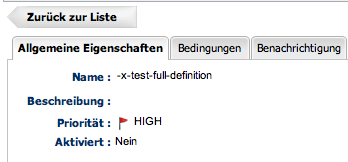
In the UI this looks like:

General view
Conditions
Notifications


Other features like dampening or recovery are not yet implemented.

To be complete, the content of /tmp/foo looks like this:


{
"id": 0,
"name": "-x-test-full-definition",
"enabled": false,
"priority": "HIGH",
"recoveryId": 0,
"conditionMode": "ANY",
"conditions": [
{
"id": 0,
"name": "AVAIL_GOES_DOWN",
"category": "AVAILABILITY",
"threshold": null,
"option": null,
"triggerId": null
}
],
"notifications": [
{
"id": 0,
"senderName": "Direct Emails",
"config": {
"emailAddress": "enoch@root.org"
}
}
]
}

Saturday, December 15, 2012

Android and locations - a sad storry

So I am e.g. browsing Google Maps and have a GPS fix. Now I switch to Ingress or c:geo from the recently used apps list. And what happens?

GPS-fix icon in the upper left corner turns off, app changes and I have to wait between 6 and 15sec to get a new fix even if I did not move a centimeter.

Worse is that the position during the switch-over is sometimes kilometers off, as the app uses the location from the network, which depends on the size of the network cell and the location of the next tower. If you are in a location based app, that switchover can even cause additional network traffic as e.g. maps needs to load a new tile or g:geo does the "nearby caches" search in a non-interesting area.

The technical background is the application lifecycle in Android and the recommendations to safe battery just don't mix.
When app one (e.g. maps) is brought to background, the GPS receiver is switched off, then the switchover happens and only after the onResume() has finished, it is turned on again. Unfortunately the Android system itself seems not to cache the GPS info for a little time and offers that to the next app as a potential current location, but just falls back on network location.

A solution could be for the Android system to cache the GPS location and add an uncertainty linear to the age of the fix. So while the location + uncertainty is smaller than the distance from the location obtained from network, the GPS location would be used. And then after the mentioned 6-15 sec, the real GPS data would take over.

Friday, November 09, 2012

JAX-RS 2 client in RHQ (plugins)

When my fellow Red Hatter Bill Burke recently wrote about the new features in JAX-RS 2.0, I started to consider using the new Client api to use in tests and plugins. Luckily Bill provided a 3.0-beta-1 release of RESTEasy that I started with.

To get this going, I started with the plugin case and wrote my few lines of code in the editor. All red, as the classes were not known yet. After many iterations in the editor and the standalone-pc, I ended up with this list of dependencies, which all need to be included in the final plugin jar:

                <artifactItem>
<groupId>org.jboss.resteasy</groupId>
<artifactId>resteasy-client</artifactId>
</artifactItem>
<artifactItem>
<groupId>org.jboss.resteasy</groupId>
<artifactId>jaxrs-api</artifactId>
</artifactItem>
<artifactItem>
<groupId>org.jboss.resteasy</groupId>
<artifactId>resteasy-jaxrs</artifactId>
</artifactItem>
<artifactItem>
<groupId>org.apache.httpcomponents</groupId>
<artifactId>httpclient</artifactId>
</artifactItem>
<artifactItem>
<groupId>org.apache.httpcomponents</groupId>
<artifactId>httpcore</artifactId>
</artifactItem>
<artifactItem>
<groupId>org.jboss.resteasy</groupId>
<artifactId>resteasy-jackson-provider</artifactId>
</artifactItem>
<artifactItem>
<groupId>org.codehaus.jackson</groupId>
<artifactId>jackson-jaxrs</artifactId>
</artifactItem>
<artifactItem>
<groupId>org.codehaus.jackson</groupId>
<artifactId>jackson-core-asl</artifactId>
</artifactItem>
<artifactItem>
<groupId>org.codehaus.jackson</groupId>
<artifactId>jackson-mapper-asl</artifactId>
</artifactItem>
</artifactItems>


Still I got errors that there is no provider for a media type of application/json available. It turned out, that the RHQ plugin container's classloader does not honor the META-INF/services/javax.ws.rs.ext.Providers entry (or any of the services there, so I had to explicitly enable them in code:


javax.ws.rs.client.Client client = ClientFactory.newClient();
client.configuration().register(org.jboss.resteasy.plugins
.providers.jackson.ResteasyJacksonProvider.class);
client.configuration().register(org.jboss.resteasy.plugins
.providers.jackson.JacksonJsonpInterceptor.class);


Now the client works as intended. At there is quite a number of jars involved, I am thinking of providing an abstract REST plugin, that provides the jars and the basic connection functionality, so that other plugins can build on top just like we have done that with the jmx-plugin.

I was also trying to get this to work with Jersey, but failed somewhere in the maven world, as it failed for me after downloading half of the Glassfish distribution.

One interesting question to me is about the target group of this JAX-RS 2.0 client framework, as the Jersey and RESTEasy implementations seem to grow rather large (which does not matter too much for servers or on the desktop), so that Android apps are less likely to use that and will rather fall back to home grown solutions. With the huge number of mobile phones, this could perhaps the end also mean that nobody will touch the Client framework and falls back to those smaller homegrown solutions on mobile and desktop.

Thursday, October 25, 2012

REST/JAX-RS documentation generation


As I may have mentioned before :-) we have added a REST api to RHQ. And one thing we have clearly found out during development and from feedback by users is that the pure linking feature of REST may not be enough to work with a RESTful api and that some. Our Mark Little posted an article on InfoQ recently that touches the same subject.

Take this example:


@PUT
@Path("/schedule/{id}")
@Consumes({MediaType.APPLICATION_JSON, MediaType.APPLICATION_XML})
Response updateSchedule(int scheduleId,
MetricSchedule in,
@Context HttpHeaders headers);


So this is a PUT request on some schedule with an id identifier where a certain MetricSchedule thing should be supplied. And then we get some Response back, which is just a generic
JAX-RS "placeholder".

Now there is a cool project called Swagger with a pretty amazing interactive UI to run REST requests in the browser against e.g. the pet store.

Still this has some limitations
  • You need to deploy wagger, which not all enterprises may want
  • The actual objects are not described as I've mentioned above

Metadata via annotations


The metadata in Swagger to define the semantics of the operations and the simple parameters is defined on the Java source as annotations on the restful methods like this:


@PUT
@Path("/schedule/{id}")
@Consumes({MediaType.APPLICATION_JSON,MediaType.APPLICATION_XML})
@ApiOperation(value = "Update the schedule (enabled, interval) ",
responseClass = "MetricSchedule")
@ApiError(code = 404, reason = NO_SCHEDULE_FOR_ID)
Response updateSchedule(
@ApiParam("Id of the schedule to query") @PathParam("id") int scheduleId,
@ApiParam(value = "New schedule data", required = true) MetricSchedule in,
@Context HttpHeaders headers);


which is already better, as we now know what the operation is supposed to do, that it will return an
object of type MetricSchedule and for the two parameters that are passed we also get
a description of their semantics.

REST docs for RHQ


I was looking on how to document the stuff for some time and after finding the Swagger stuff it became clear to me that I do not need to re-invent the annotations, but should (re)use what is there. Unfortunately the annotations were deep in the swagger-core module.

So I started contributing to Swagger - first by splitting off the annotations into
their own maven module so that they do not have any dependency onto other modules, which makes
it much easier to re-use them in other projects like RHQ.

Still with the above approach the data objects like said MetricSchedule are not documented. In order to do that as well, I've now added a @ApiClass annotation to swagger-annotations, that allows to also document the data classes (a little bit like JavaDoc, but accessible from an annotation processor). So you can now do:


@ApiClass(value = "This is the Foo object",
description = "A Foo object is a place holder for this blog post")
public class Foo {
int id;
@ApiProperty("Return the ID of Foo")
public int getId() { return id; }


to describe the data classes.

The annotations themselves are defined in the following maven artifact:


<dependency>
<groupId>com.wordnik</groupId>
<artifactId>swagger-annotations_2.9.1</artifactId>
<version>1.1.1-SNAPSHOT</version>
</dependency>

which currently (as I write this) is only available from the snapshots repo


<!-- TODO temporary for the swagger annotations -->
<id>sonatype-oss-snapshot</id>
<name>Sonatype OSS Snapshot repository</name>
<url>https://oss.sonatype.org/content/repositories/snapshots</url>
</repository>

The generator


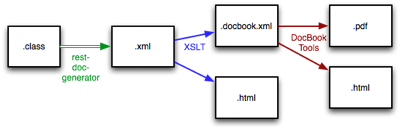
Based on the annotations I have written an annotation processor that analyzes the files and creates an XML document which can then be transformed via XSLT into HTML or DocBookXML (which can then be transformed into HTML or PDF with the 'normal' Docbook tool chain.

Tool chain


You can find the source for the rest-docs-generator in the RHQ-helpers project on GitHhub.

The pom.xml file also shows how to use the generator to create the intermediate XML file.

Examples


You can see some examples of the generated output (for some slightly older version of the generator in the RHQ 4.5.1 release files on sourceforge, as well as the in the documentation for JBoss ON, where our docs team just took the input and fed it into their DocBook tools chain almost without and change.

Postprocessing…


If you are interested to see how the toolchain is used in RHQ, you can look at the pom.xml file from the server/jar module ( search for 'REST-API' ).


Project independent


One thing I want to emphasize here is that the generator with its toolchain is completely independent from RHQ and can be reused for other projects.


Thursday, October 11, 2012

Another nice JBoss OneDayTalk is over (updated)


Yesterday I was at the OneDayTalk conference organized by the Munich JBoss User Group.

And as in the last two years this was a nice conference with an interested audience and it was good
to meet with colleagues again.

This year I was talking about "RHQ and its interfaces" - and other than some other speakers, I enjoyed to just give my talk in German :)
My slides are available as PDF.

Update: A recording of my talk (which I held in German) is now available:

RHQ und seine Schnittstellen from Heiko W. Rupp on Vimeo.


Thanks for the Munich JBug to organize this nice conference and to allow me to present there.

Thursday, October 04, 2012

RHQ 4.5.1 released


I am pleased to announce the immediate availability of RHQ 4.5.1.
RHQ is a system for management and monitoring of resources like application servers
or databases and can be extended by writing plugins.

Actually I wanted to announce 4.5.0 a week ago, but a first user report showed an
error in the upgrade path from a previous version, so we have pulled that release
and fixed the bug along with another one and have now created a fresh 4.5.1 release.

Notable changes are:

  • Python support in the Command Line Interface (CLI)
  • Support for importing of scripts in the CLI
  • Enhancements in the JBossAS7 plugin
  • Enhancements in the REST API
  • Events tab allows to filter by date range
  • Postgres 9.2 is now supported as backend database
  • The Sigar library has been updated.


Special thanks goes to Elias Ross and Richard Hensman for their contributions.

Maven artifacts have been uploaded to the JBoss Nexus repo and should show up on maven central soon.

You can find the full release notes, that also contain a download link on the RHQ wiki.

This time we have included the full output from git shortlog for the commits of the release. Please tell us if this is useful for you.

Heiko on behalf of the RHQ team

Thursday, July 12, 2012

Introducing the No-op plugin for RHQ

Introducing the No-op plugin for RHQ

“A no-op plugin, does that make sense?” you will ask - and indeed it makes sense when you look at recent developments inside RHQ with the REST-api and also the support for jar-less plugins.

The no-op plugin is meant to support jar-less plugins that are written to define ResourceTypes on the server along with their metrics in order to be usable via the REST api, but where no resources are supposed to be found via the classic java-agent.

A concrete use case is the work our GSoC student Krzysztof is doing by bridging monitoring data from CIMmons deployed e.g. in RHEL servers to RHQ resources. Here we have the (possible) need to define resource types that will only be fed via the REST api.

How do I use this?

Basically you write a plugin descriptor (either in the classical way which you then put into a plugin jar) or with the name of *-rhq-plugin.xml and then deploy that into the server. The contents of this descriptor then refer to the No-op plugin - first in the <plugin> elements’s package declaration:

<plugin name="bar-test"
version="4.5.1"
displayName="Jar less plugin test"
description="Just testing"
package="org.rhq.plugins.noop”
xmlns="urn:xmlns:rhq-plugin"
xmlns:c="urn:xmlns:rhq-configuration">

The next part is then to declare a dependency on the No-op plugin to be able to use the classes:

   <depends plugin="No-op" useClasses="true"/>

And finally to use the NoopComponent for the discovery and component classes of <server>s and <service>s:

    <server name="test"
discovery="NoopComponent"
class="NoopComponent"
>

</server>
</plugin>

A plugin defined like this then defines metrics etc. just like every other plugin. This is the plugin info:

Plugin info


And the metric definition templates:

Metric definition templates

Jar-less plugins for RHQ

JAR-less plugins for RHQ

Mazz has written a few times about the Custom-JMX plugin (funnily enough I did not find a newer post to link to), which is basically a plugin descriptor, that re-uses the classes from the base JMX plugin.

While this is very powerful, it has the small usability drawback of requiring to wrap the descriptor into a jar file to be recognized by the server (and the agents).

I have now implemented BZ 741682 which allows to deploy plugin descriptors only. For this to work

  • the file needs to be called *-rhq-plugin.xml (e.g. foo-rhq-plugin.xml)
  • the classes of the plugin need to already be present on the agent

The latter can be achieved by putting a depends directive into the descriptor:

<depends plugin="JMX" useClassed="true"/>

In the following example you see the bar-rhq-plugin.xml file picked up from the $SERVER/plugins directory
(the "drop-box") and placed into the plugins directory inside the app:

09:18:55,160 INFO  [PluginDeploymentScanner] Found plugin descriptor at 
    [/im/dev-container/plugins/bar-rhq-plugin.xml] and placed it at 
    [/im/dev-container/jbossas/server/default/deploy/rhq.ear/rhq-downloads/rhq-plugins/bar-rhq-plugin.xml]

Next is the transformation of this plugin descriptor into a jar file - if this is successful, the now obsolete plugin descriptor is removed.

09:18:55,403 INFO  [AgentPluginScanner] Found a plugin-descriptor at 
    [/im/dev-container/jbossas/server/default/deploy/rhq.ear/rhq-downloads/rhq-plugins/bar-rhq-plugin.xml],
    creating a jar from it to be deployed at the next scan
09:18:55,411 INFO  [AgentPluginScanner] Deleted the now obsolete plugin descriptor: true

At the next scan of the deployment scanner, the scanner will pick up this generated jar and deploy it like any other plugin:

09:19:26,470 INFO  [ProductPluginDeployer] Discovered agent plugin [bar-test]
09:19:26,474 INFO  [ProductPluginDeployer] Deploying [1] new or updated agent plugins: [bar-test]
09:19:26,656 INFO  [ResourceMetadataManagerBean] Persisting new ResourceType [bar-test:test(id=0)]...
09:19:29,344 INFO  [ProductPluginDeployer] Plugin metadata updates are complete for [1] plugins: [bar-test]

The last step would then be to run plugins update on the agent to get this new plugin from the server and to deploy it into the agent.

Wednesday, June 20, 2012

RHQPocket updated


I have worked over the last days on improving RHQPocket, an Android application that serves as an example client for RHQ. Most of the features of RHQPocket will work (best) with a current version of the RHQ server (from current master).

The following is a recording I made that shows the current state.

Update on RHQPocket from Heiko W. Rupp on Vimeo.


The video has been recorded with QuickTime player with the running emulator. I first tried this with the "classical" emulator, but this used 100% cpu (1 core) and with recording turned on, this was so slow that simple actions that are normally immediate, would take several seconds.

My next try was to film my real handset, but too much environmental light and reflexions made this a bad experience. After I heard that others had successfully installed the hardware accelerated GPU and the virtualized x86 image for the emulator I went that route and the CPU usage from the emulator went from 100% before to around 15-20% (home screen), so I went that route for recording.

You can find the full source code on GitHub - contributions and feedback are very welcome.
If you don't want to build from source, you can install the APK from here.

Thursday, June 14, 2012

RHQ REST api: Support for JSONP (updated)


I have just committed support for JSONP to the RHQ REST-api.

Update: In the first version a special media type was required. This is now removed, as jQuery seems to have issues sending this type. Also the default name for the callback parameter has been renamed to jsonp.


To use it you need to pass a parameter for the callback. Lets look at an example:


$ curl -i -u rhqadmin:rhqadmin \
http://localhost:7080/rest/1/alert?jsonp=foo \
-Haccept:application/json
HTTP/1.1 200 OK
Server: Apache-Coyote/1.1
Pragma: No-cache
Cache-Control: no-cache
Expires: Thu, 01 Jan 1970 01:00:00 CET
X-Powered-By: Servlet 2.4; JBoss-4.2.0.CR2
Content-Type: application/javascript
Transfer-Encoding: chunked
Date: Thu, 14 Jun 2012 09:25:09 GMT

foo([{"name":"test","resource":{"typeName":null, ……..])


The name of the callback parameter is jsonp and the name of the callback function to return is
foo. In the output of the server you see how the json-data is then wrapped inside foo().
The wrapping will only happen when both the right content-type is requested and the callback parameter is present.

The content type returned is then application/javascript.


Setting the name of the callback parameter

Then name of the callback parameter (jsonp in above example) can be set in web.xml :


<filter>
<filter-name>JsonPFilter</filter-name>
<filter-class>org.rhq.enterprise.rest.JsonPFilter</filter-class>
<init-param>
<param-name>filter.jsonp.callback</param-name>
<param-value>jsonp</param-value>
<description>Name of the callback to use for JsonP /description>
</init-param>
</filter>

Monday, May 28, 2012

RHQ REST api: added support for Group Definitions


I've just added some support for GroupDefinitions (aka "DynaGroups") to RHQ.

The following shows some examples:

List all definitions:

$ curl -i --user rhqadmin:rhqadmin http://localhost:7080/rest/1/group/definitions
[{"name":"group1",
"id":10001,
"description":"just some random test",
"expression":["groupby resource.type.plugin","groupby resource.type.name"],
"recursive":false,
"recalcInterval":180000,
"generatedGroupIds":[10082,10091]},
{"name":"platforms",
"id":10002,
"description":"",
"expression":["resource.type.category = PLATFORM","groupby resource.name"],
"recursive":false,
"recalcInterval":0,
"generatedGroupIds":[10152]}
]
Get a single definition by id:

$ curl -i --user rhqadmin:rhqadmin http://localhost:7080/rest/1/group/definition/10002
{"name":"platforms",
"id":10002,
"description":"",
"expression":["resource.type.category = PLATFORM","groupby resource.name"],
"recursive":false,
"recalcInterval":0,
"generatedGroupIds":[10152]
}


You see in the above examples that the actual expression is encoded as a list with each line being an item in the list. The recalculation interval needs to be given in milliseconds.

Delete a definition (by id):

$ curl -i --user rhqadmin:rhqadmin http://localhost:7080/rest/1/group/definition/10031 -X DELETE
Create a new definition:

$ curl -i --user rhqadmin:rhqadmin http://localhost:7080/rest/1/group/definitions \
-HContent-Type:application/json -HAccept:application/json -X POST \
-d '{"name":"test1","description":"Hello","expression":["groupBy resource.name"]}'
HTTP/1.1 201 Created
Location: http://localhost:7080/rest/1/group/definition/10041


For creation a name is required. The location of the created group definition is returned in the header of the response.

And finally to update a definition:

curl -i --user rhqadmin:rhqadmin http://localhost:7080/rest/1/group/definition/10041?recalculate=true \
-HContent-Type:application/json -HAccept:application/json -X PUT \
-d '{"name":"test4","description":"Hello","expression":["groupBy resource.name"]}'


By passing the query-param recalculate=true we can trigger a re-calculation of the groups defined by this group definition.